Blog

Your blog category

Top 7 Tools for Content Creation

Tools for Content Creation

Tools for Content Creation today is more competitive than ever. Whether you’re building a personal brand, growing a business, or starting a YouTube channel, the right tools can save time, improve quality, and help you stay consistent. Here’s a complete guide to the top 7 content creation tools and how they can transform your workflow. 1. Tools for Content Creation : Canva – Easy Graphic Design   Canva is one of the most beginner-friendly design tools available. It allows you to create social media posts, posters, thumbnails, and presentations using ready-made templates. Even if you have zero design experience, you can produce professional-looking content within minutes. It’s ideal for Instagram posts, ads, and branding materials. 2. Adobe Creative Cloud – Professional Content Suite   Adobe Creative Cloud is a powerful suite that includes tools like Photoshop, Premiere Pro, and Illustrator. It’s best suited for professionals who need high-quality graphics, videos, and animations. While it has a learning curve, the level of customization and output quality is unmatched. 3. Tools for Content Creation : Cap Cut – Video Editing Made Simple   Cap Cut is perfect for creating short-form videos like Instagram Reels, TikTok, and YouTube Shorts. It offers built-in effects, transitions, subtitles, and music, making video editing fast and efficient. It’s widely used by creators who want viral-style content without complicated software. 4. Grammarly – Improve Your Writing   Grammarly helps you write clear and error-free content. Whether you’re creating captions, blogs, or emails, it checks grammar, spelling, and tone. It also suggests better word choices, making your content more engaging and professional. 5. Notion – Plan and Organize Content   Notion is an all-in-one workspace where you can plan your content calendar, store ideas, and manage projects. It’s especially useful for creators who need to stay organized and consistent. You can track deadlines, scripts, and campaigns in one place. 6. Descript – Smart Audio & Video Editing   Descript is a unique tool that lets you edit videos and podcasts like a text document. You simply edit the transcript, and the video changes automatically. It also includes features like voice cloning and automatic captions, making it a great choice for podcasters and YouTubers. 7. DaVinci Resolve – Advanced Video Editing   DaVinci Resolve is a professional-grade video editing tool used in filmmaking. It offers advanced color correction, audio editing, and visual effects. Despite its powerful features, it also has a free version, making it accessible to serious creators who want high-quality videos. Final Thoughts   Choosing the right tools depends on your goals and skill level. Beginners can start with simple tools like Canva and Cap Cut, while advanced creators may prefer Adobe Creative Cloud or DaVinci Resolve for more control. The key to success isn’t using many tools—it’s mastering a few that fit your workflow. A smart combination like design (Canva), video editing (Cap Cut), writing (Grammarly), and planning (Notion) can cover almost all your content needs. If you need any help with our services you can contact us.

Tools for Content Creation Read More »

Top 7 Tools for Content Creation in 2026

top 7 tools for content Creations in 2026

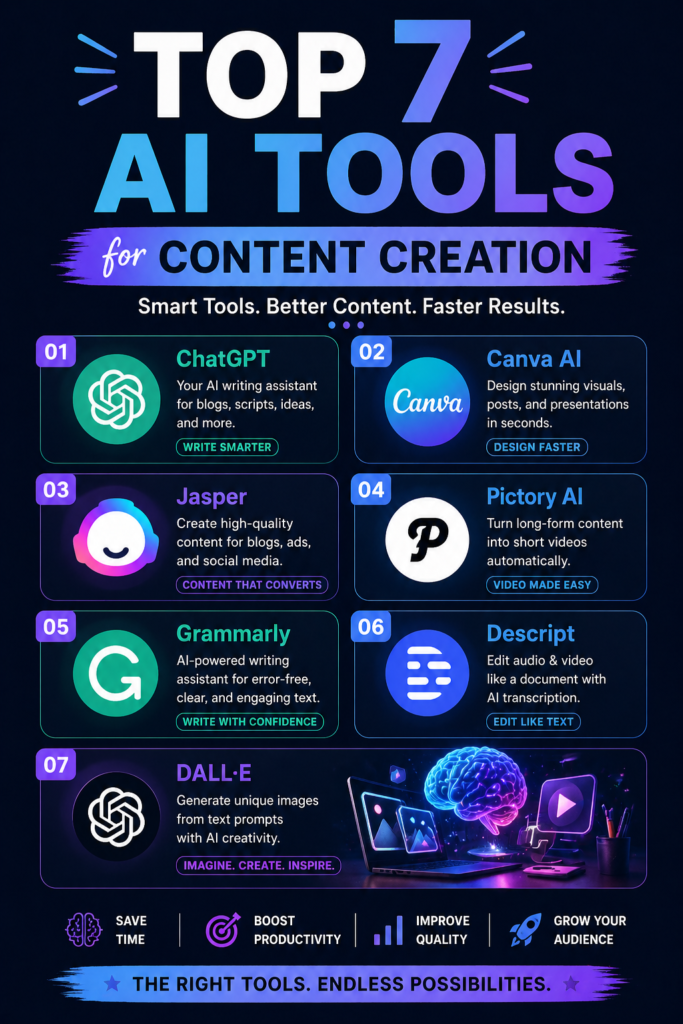
These tools empower bloggers, marketers, video producers, and social media experts by streamlining ideation, writing, design, SEO, and editing workflows. Selected based on popularity, versatility, and expert reviews, they blend AI innovation with user-friendly interfaces to boost productivity.   ChatGPT ChatGPT is one of the most versatile tools for generating and repurposing text content. You can use it to brainstorm blog titles, outline articles, rewrite drafts, and even create social‑media captions or email copy. What makes it powerful is its ability to switch between short and long formats, follow style prompts, and adapt tone (formal, casual, persuasive, etc.). Grammarly Grammarly sits on top of your writing workflow to catch grammar, spelling, punctuation, and style mistakes. It also scores your text for clarity, engagement, and tone, which is especially useful if you publish blogs, newsletters, or sales pages. Canva Canva is the go‑to tool for creating thumbnails, social‑media posts, infographics, and presentations without needing design experience. It offers thousands of templates, drag‑and‑drop editing, and brand‑kit features so you can reuse colors, fonts, and logos. You can also design lead magnets (eBooks, checklists), YouTube banners, and Instagram carousels quickly, which helps you maintain a strong visual identity across platforms. 4. Adobe Express Adobe Express is an all-in-one, cloud-based content creation app designed for quickly making social media posts, videos, images, and documents using templates and AI. InVideo InVideo is ideal for creators who want to turn scripts or blog posts into short‑form videos for YouTube shorts, Reels. It offers ready‑made templates, stock footage libraries, and auto‑subtitle generation so you don’t need advanced editing skills or a big camera setup. You can paste your script, pick a template, add background music, and export a polished video in minutes, making it perfect for repurposing blogs into visual content. Descript Descript is a video and podcast‑editing tool that lets you edit audio and video by editing a transcript, almost like editing a document. It transcribes your recordings, highlights filler words, and lets you delete or shorten parts by deleting text, which speeds up editing dramatically. You can also add voice‑over clips, basic visuals, and captions, so it’s great for podcasters and YouTubers who want clean, professional output without complex software. WordPress WordPress is a free, open-source Content Management System (CMS) used to build and manage websites without needing to code. Powering over 40% of all websites, it allows users to create blogs, business sites, or stores using a visual interface, themes for design, and plugins for added functionality.   

top 7 tools for content Creations in 2026 Read More »

7 Must‑Use Content Creation Tools in 2026

1. ChatGPT – Your AI Writing Assistant ChatGPT is one of the most versatile tools for generating and repurposing text content. You can use it to brainstorm blog titles, outline articles, rewrite drafts, and even create social‑media captions or email copy. What makes it powerful is its ability to switch between short and long formats, follow style prompts, and adapt tone (formal, casual, persuasive, etc.). For best results, give it a clear brief: topic, target audience, word count, and key points you want covered. 2. Grammarly – Polish Your Writing Grammarly sits on top of your writing workflow to catch grammar, spelling, punctuation, and style mistakes. It also scores your text for clarity, engagement, and tone, which is especially useful if you publish blogs, newsletters, or sales pages. Use it as a final check before publishing: paste your draft into Grammarly, review the suggestions, and tweak readability and tone so your content feels professional and consistent. 3. Canva – Effortless Visual Content Canva is the go‑to tool for creating thumbnails, social‑media posts, infographics, and presentations without needing design experience. It offers thousands of templates, drag‑and‑drop editing, and brand‑kit features so you can reuse colors, fonts, and logos. You can also design lead magnets (eBooks, checklists), YouTube banners, and Instagram carousels quickly, which helps you maintain a strong visual identity across platforms. 4. Semrush Content Toolkit – SEO‑Optimized Articles Semrush’s Content Toolkit helps you write and optimize articles that rank better in search engines. It gives you keyword suggestions, content structure ideas, and SEO‑related recommendations so you naturally include relevant terms without “keyword stuffing.” You can start by finding a topic with Semrush, then use the in‑editor guidance to structure headings, add internal links, and improve readability while keeping your content search‑friendly. 5. InVideo – AI‑Powered Video Creation InVideo is ideal for creators who want to turn scripts or blog posts into short‑form videos for YouTube shorts, Reels, or TikTok. It offers ready‑made templates, stock footage libraries, and auto‑subtitle generation so you don’t need advanced editing skills or a big camera setup. You can paste your script, pick a template, add background music, and export a polished video in minutes, making it perfect for repurposing blogs into visual content. 6. Descript – Edit Video & Audio Like Text Descript is a video and podcast‑editing tool that lets you edit audio and video by editing a transcript, almost like editing a document. It transcribes your recordings, highlights filler words, and lets you delete or shorten parts by deleting text, which speeds up editing dramatically. You can also add voice‑over clips, basic visuals, and captions, so it’s great for podcasters and YouTubers who want clean, professional output without complex software. 7. CapCut – Simple Mobile‑First Editing CapCut is a free, mobile‑and‑desktop‑friendly editor perfect for fast‑paced social‑media content. It includes auto‑captioning, transitions, effects, and templates that help you create polished Reels and Shorts in a few taps. If you’re filming on your phone, CapCut lets you trim clips, add music, and adjust color grading so your content looks more professional without spending hours in the editor. Using these seven tools together—you writing in ChatGPT, polishing with Grammarly, designing visuals in Canva, optimizing with Semrush, and producing video with InVideo, Descript, and CapCut—you can build a full content engine in 2026 that’s fast, scalable, and consistent.

7 Must‑Use Content Creation Tools in 2026 Read More »

Shopping Cart

SPIN TO WIN!

  • Try your lucky to get discount coupon
  • 1 spin per email
  • No cheating
Try Your Lucky
Never
Remind later
No thanks